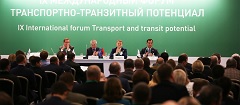
State regulation of road, rail and water transport was the main theme of the forum.
The Ninth International Transport and Transit Potential Forum opened in Saint Petersburg on Wednesday, 21 September, under the auspices of the Saint Petersburg — Maritime Capital of Russia project, headed by Sergey Ten, deputy chairman of the State Duma transport committee.
Around 400 delegates from 60 Russian regions and 10 other countries gathered for the event. The forum was supported by the Federation Council and the State Duma, with the participation of senior figures from the Ministry of Transport and the Ministry of Industry and Trade and from the federal agencies that design and deliver transport policy.
The programme opened with a plenary session on state policy and the regulatory framework of the transport sector. Ten welcomed participants and said he was confident that open public discussion of the sector’s problems is the best way to overcome them. In his words, significant changes had taken place in the sector, helping to improve its performance, and much of this was due to the work of the Saint Petersburg — Maritime Capital of Russia project, aimed at finding effective ways to make the Russian transport system more competitive.
He urged participants to take an active part in the discussions, recalling that a resolution would be drawn up and sent to all the relevant public authorities. “The resolutions of the project’s concluding discussions become a guide to action for the executive and the legislature. The document produced by this forum will be used in the legislative work of the State Duma transport committee,” Ten said.
State regulation of road, rail and water transport was the main platform for debate on the first working day. Participants discussed the most pressing questions facing the country, including the conduct of inspection and supervision, current tasks in customs, tariff and tax policy, improvements to the carriage process, public–private partnership and making the sector more attractive to investors. Separate sessions were devoted to the prospects of the Northern Sea Route and to the scheme for charging lorries with a maximum permissible mass above twelve tonnes.
The second day covered two large areas of work: transport policy in the context of Russia’s foreign economic activity, and improving logistics at transport companies.
To give the event practical weight, a public resolution with the participants’ proposals and recommendations was prepared and sent to the Government of Russia and the relevant committees of the Federal Assembly, with a view to improving legislation and state regulation across various aspects of transport.