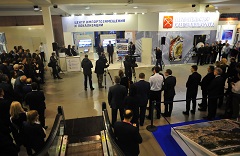
The Transport Union of the North-West took part in a session of the public council on using the capacity of domestic manufacturers in import substitution and localisation in transport infrastructure. The event was held as part of the week of the committee for transport infrastructure development, chaired by the head of the committee Sergey Kharlashkin, at the Centre for Import Substitution and Localisation.
Reports summing up the state of the sector were given by Andrey Mayorov, head of the urban planning and transport modelling department of the Centre for Transport Planning, and Artur Ershov, head of the geological and geodetic department of the committee for urban development and architecture. Aleksey Kozyutenko, head of corporate sales at SK, presented the possibilities of press-vacuum technology. Natalya Maydanova, deputy head of the laboratory at ABZ-1, told participants about progress in producing coloured asphalt from Russian ingredients and the ways it can be used in a city. The reports concluded with Aleksandr Martazov, lead designer at ETA, presenting a technology for the electrical heating of concrete that opens new possibilities in building transport facilities.
Summing up, Lev Kaplan, director of the Saint Petersburg union of construction companies Soyuzpetrostroy, noted that the committee’s business week had produced a great many innovative proposals which now need to be collected, assessed by experts and pushed into practice. Quoting President Vladimir Putin’s words that “import substitution is not a fetish but a spur to developing high technology”, Kaplan stressed: “We should not abandon cooperation with Western partners entirely, but while drawing on the most interesting examples we must above all develop our own science and new technology. Quality must become the decisive characteristic of what we build.”
The themed week ran until 27 November. Over that period the committee for transport infrastructure development set out to identify the most pressing questions facing the sector and to find answers among domestic manufacturers, taking the import substitution programme as far as it will go.